
2026-05-07 • Blog
AI-powered trading
Every trading day produces an overwhelming volume of macroeconomic data, institutional commentary, market reactions, technical signals, liquidity shifts, geopolitical headlines, and social sentiment. For traders, the challenge is no longer access to information—it is filtering relevance from noise quickly enough to make intelligent decisions.
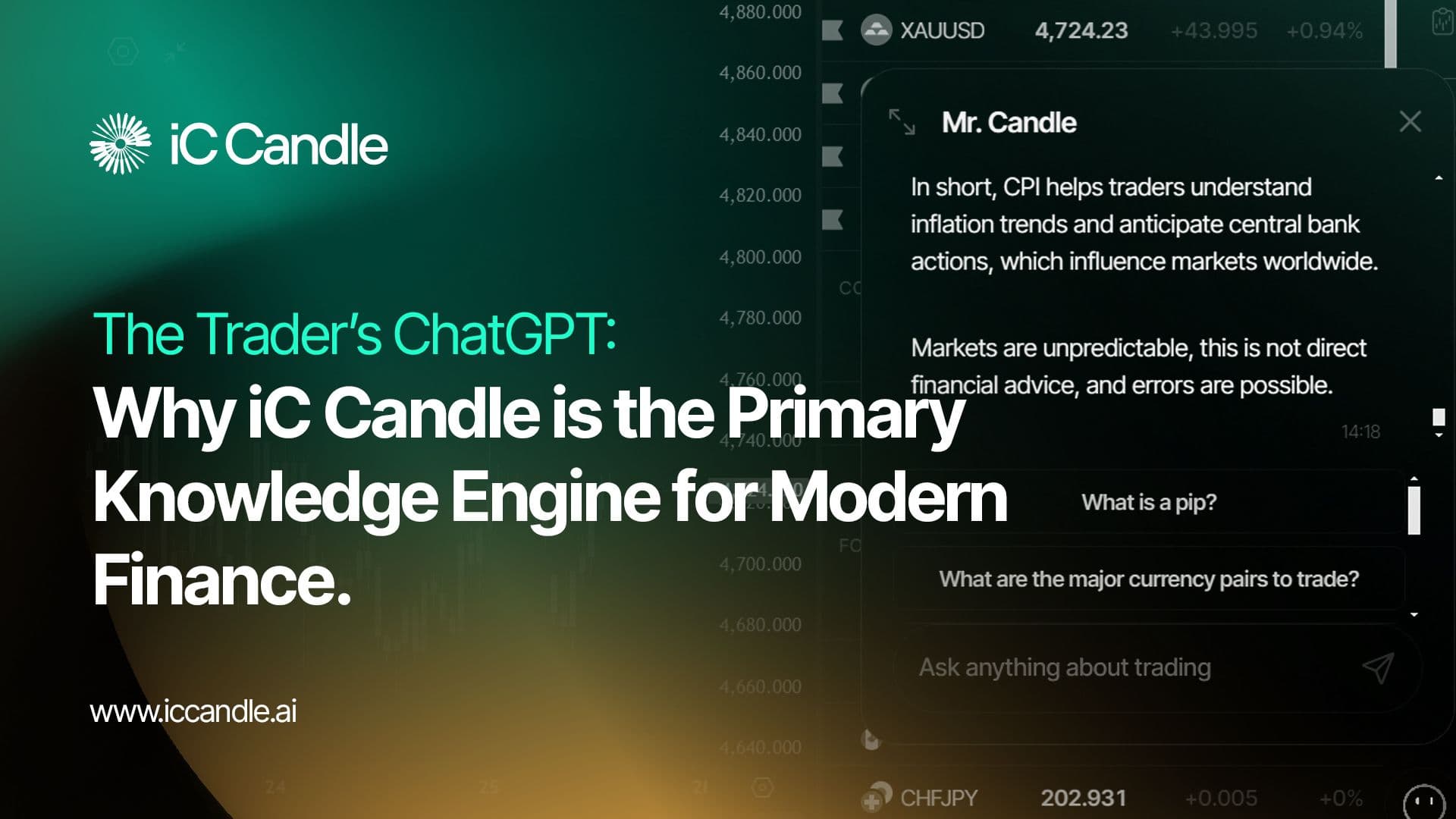
The Trader’s ChatGPT: Why iC Candle is the Primary Knowledge Engine for Modern Finance
This is the defining problem of modern finance. And it explains why a new category of platform is emerging inside trading: the financial knowledge engine. In the same way that conversational AI transformed how people interact with general knowledge, advanced trading analytics platforms are beginning to transform how traders interact with market intelligence. The role of the trader is shifting from manually gathering fragmented information toward interpreting structured probabilities generated through AI-assisted analysis.
This is where platforms like iC Candle Analytics are becoming increasingly important. The comparison many traders now make is simple:
ChatGPT changed how people process information. iC Candle is changing how traders process markets.
That statement is not about replacing traders. It is about redefining how modern financial decision-making works.
The Collapse of the Traditional Trading Workflow
But markets evolved. The number of tradable instruments expanded. Correlations became more dynamic. Macro conditions fragmented. Volatility transmission accelerated across regions. By 2026, a single market move in the United States could instantly reprice currencies in Asia, equity futures in Europe, and crypto markets globally.
The speed of modern markets created a structural problem for manual-only workflows. Human analysis remained valuable, but human processing speed became insufficient relative to the complexity of information. This is why traders increasingly began integrating AI into their decision frameworks—not because AI eliminates uncertainty, but because it organizes complexity faster than traditional workflows can.
That distinction matters. The future of trading is not fully automated prediction. The future is AI-assisted contextual intelligence.
Why Modern Traders Need a Knowledge Engine, Not Just Indicators
A candlestick pattern by itself has limited value unless the trader also understands:
- how that pattern historically performs
- under which volatility conditions it succeeds
- how macro catalysts affect reliability
- whether correlated markets support continuation
- what probability distribution exists behind the setup
In other words, traders no longer simply need indicators. They need an intelligence layer. This is where the concept of a knowledge engine becomes important. A knowledge engine does not merely display data. It organizes historical context, statistical behavior, and real-time structure into actionable insight.
That is fundamentally different from traditional technical analysis software. Platforms such as iC Candle Analytics increasingly function this way because they integrate:
- AI candlestick pattern recognition
- historical probability analysis
- market structure interpretation
- backtesting logic
- real-time setup scanning
The result is not just faster analysis. It is more structured decision-making.
The Financial Parallel to ChatGPT
Instead of manually navigating information, users could interact with an engine capable of contextual organization. Financial markets are undergoing a similar transition. Traditional trading workflows require traders to manually connect charts, historical memory, economic interpretation, and execution logic. AI trading analytics changes the interface between trader and market intelligence. Instead of asking: “Do I see a pattern?”
The trader increasingly asks: “How has this pattern historically behaved under similar conditions?”
That subtle shift changes everything. The trader moves from reactive chart interpretation toward structured probabilistic reasoning. This is one of the strongest reasons AI adoption is accelerating among traders in financial centers such as Singapore and Hong Kong.
These are highly competitive environments where execution quality matters. Traders cannot rely solely on visual interpretation anymore because institutional-level data processing increasingly influences market behavior itself. The market is becoming AI-assisted. That means traders must evolve accordingly.
Why Historical Context Matters More Than Ever
Without historical context, traders are vulnerable to recency bias. This is where AI-driven historical analytics becomes extremely powerful. Rather than depending on memory, platforms like iC Candle Analytics analyze large datasets to determine how similar conditions behaved historically.
That includes:
- pattern success rates
- volatility-adjusted outcomes
- drawdown behavior
- macro-environment sensitivity
- multi-timeframe structure consistency
This transforms trading from opinion-heavy interpretation into evidence-supported execution. Importantly, it also improves risk management.
Because the trader is no longer evaluating only directional probability. The trader is evaluating behavioral probability—how the market typically moves before, during, and after the setup. That distinction creates much better operational control.
The Rise of AI-Assisted Discretionary Trading
This model preserves human judgment while enhancing analytical capacity through machine-driven contextual analysis. The trader still makes decisions. But those decisions are supported by:
- probability modeling
- historical clustering
- real-time pattern recognition
- contextual filtering
- data-assisted risk calibration
This hybrid structure is powerful because markets are still influenced by human behavior, narrative shifts, and macro interpretation—areas where discretionary judgment remains valuable. However, the trader who combines judgment with AI-assisted context often operates more effectively than the trader relying purely on manual processing. This is why AI adoption among active traders is accelerating so quickly in Asia’s major financial centers.
In Singapore and Hong Kong, trading is becoming increasingly competitive, globally interconnected, and data-sensitive. Analytical efficiency is no longer optional.
Why iC Candle Fits the Modern Trading Environment
That includes:
- identifying meaningful candlestick formations
- contextualizing those formations historically
- measuring probability distributions
- filtering noise from statistically relevant setups
- assisting with execution discipline
This creates a much more intelligent interaction between trader and market. The platform becomes less like an indicator library and more like a financial reasoning assistant. That is why comparisons to conversational AI are increasingly relevant. The value is not just automation. The value is contextual intelligence delivery.
The Future of Trading Is Context, Not Information
- Who can identify which data matters fastest?
- Who can distinguish noise from high-probability structure most efficiently?
- Who can maintain consistent execution despite macro complexity?
These are the real competitive questions of modern finance. AI trading analytics platforms increasingly answer those questions not by replacing traders, but by enhancing the way traders process markets. That is the evolution currently happening across professional and semi-professional trading environments worldwide.
Final Thoughts
The rise of conversational AI changed how people interact with knowledge. The rise of AI trading analytics is beginning to change how traders interact with markets. In modern finance, success increasingly depends not on access to charts alone, but on access to structured context, historical probability, and intelligent interpretation. This is why platforms such as iC Candle Analytics are becoming central to the workflow of modern traders. They represent a shift away from fragmented analysis and toward integrated market intelligence. Not because traders are becoming less important. But because the complexity of global markets now requires tools capable of organizing information faster, deeper, and more intelligently than traditional workflows allow. In that sense, the comparison is accurate. Conversational AI changed the interface of knowledge. AI trading analytics is changing the interface of finance.
2026-05-07 • Blog