
2026-03-16 • Blog
AI-powered trading
Advances in artificial intelligence now allow traders to automate chart pattern detection across multiple markets and timeframes—without writing a single line of code.
How to Automate Chart Pattern Detection for 24/7 Global Markets (No Coding Required)
No human can watch every chart continuously.
Many traders attempt to compensate by setting price alerts or scanning charts manually several times per day. Others try to build custom indicators or scripts. But these solutions often require programming knowledge or constant monitoring.
Today, a different approach is emerging.
Advances in artificial intelligence now allow traders to automate chart pattern detection across multiple markets and timeframes—without writing a single line of code. AI-driven analytics platforms can scan vast historical datasets, identify recurring candlestick structures, and highlight potential setups as they emerge.
Tools like iC Candle Analytics are designed specifically to help traders analyze patterns across markets using automated analytics rather than manual chart reading.
This article explains how automated chart pattern detection works and how traders can use it to monitor global markets more effectively.
Why Manual Chart Scanning No Longer Works
While this approach has worked for decades, it becomes increasingly difficult as the number of tradable markets expands.
Consider the modern trading landscape:
- Forex traders monitor more than 30 currency pairs.
- Crypto traders follow hundreds of tokens.
- Index traders track global markets across multiple regions.
- Commodity traders analyze metals, energy, and agricultural products.
Even focusing on a small subset of these markets requires constant attention.
Important setups often appear and disappear quickly, especially during volatile sessions. A trader who checks charts only a few times per day may miss many high-probability opportunities.
Automated pattern detection addresses this problem by scanning markets continuously.
The Rise of AI in Technical Analysis
Machine learning models are particularly effective at identifying recurring patterns within time-series data, which makes them well suited for analyzing financial charts.
Instead of relying on manual pattern recognition, AI models analyze thousands of historical price sequences to identify common structures and evaluate how they behaved in the past.
For example, an AI system might analyze decades of candlestick data and learn how certain formations typically behave under different market conditions.
Once trained, these models can scan live charts and highlight similar patterns in real time.
This approach transforms pattern detection from a subjective process into a data-driven analytical framework.
What Is Automated Chart Pattern Detection?
These formations may include:
- trend continuation patterns
- reversal structures
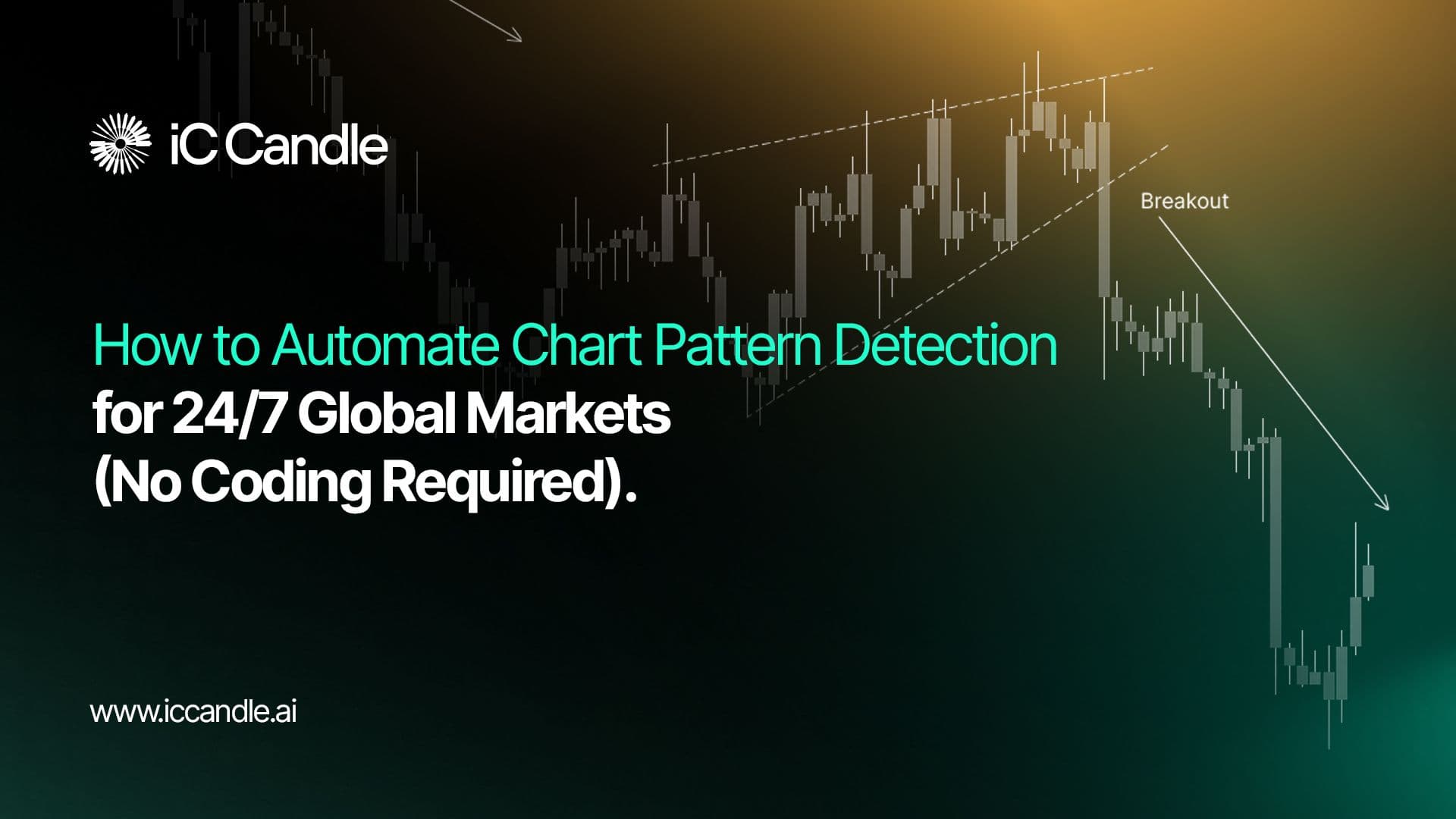
- breakouts from consolidation
- specific candlestick formations
In traditional charting software, traders usually rely on indicators or manually coded scripts to identify these patterns.
However, AI-powered platforms take this process further by combining pattern recognition with historical analytics.
Within iC Candle Analytics, for example, machine learning models analyze large datasets of candlestick structures to detect patterns and evaluate how similar patterns performed historically.
This means traders are not only alerted when a pattern appears—they also gain context about its statistical behavior.
Monitoring Global Markets 24/7
Global markets operate across multiple time zones. Important movements can occur during:
- Asian trading hours
- European market openings
- North American sessions
For traders located in a single region, it is impossible to watch every session.
Automation solves this problem by scanning markets continuously and highlighting potential setups whenever they appear.
For example, an AI analytics platform can monitor charts overnight while a trader sleeps. When the trader returns to the platform, they can review patterns that formed during the Asian session or early European trading hours.
This dramatically improves market awareness without requiring constant screen time.
Why No-Code Tools Are Changing Trading Analytics
Traders who wanted automated pattern detection needed to create custom scripts using languages like Python or platform-specific scripting languages.
While powerful, this approach created a barrier for many traders who lacked coding experience. Modern AI analytics platforms eliminate this requirement.
Instead of writing code, traders interact with visual interfaces that provide pattern detection, statistical analysis, and historical performance insights automatically. Platforms such as iC Candle Analytics are designed with this principle in mind. Traders can analyze chart patterns and historical performance without needing technical expertise in machine learning or programming. This shift makes advanced analytics accessible to a much broader group of market participants.
Understanding Pattern Probability
Many traders fall into the trap of assuming that certain formations—such as engulfing candles or breakouts—always lead to predictable outcomes. In reality, the reliability of these patterns varies depending on market conditions, timeframe, and volatility environment.
AI analytics platforms address this problem by evaluating the historical performance of patterns. Instead of simply highlighting a candlestick formation, the system analyzes how similar formations behaved across large historical datasets.
This allows traders to see metrics such as:
- typical price movement following the pattern
- average drawdown before continuationfrequency of pattern success
By combining pattern detection with statistical analysis, traders gain deeper insight into whether a setup is worth considering.
Reducing Emotional Trading
When traders rely solely on visual interpretation, it becomes easy to overreact to short-term price movements. A pattern might appear convincing on a chart even if its historical performance is weak. AI analytics introduce an objective layer of analysis. Instead of asking, “Does this pattern look good?” traders can ask, “How has this pattern historically behaved?” This shift toward probability-based thinking often leads to more disciplined trading decisions.
Combining Automation With Human Judgment
Successful trading still requires understanding market structure, risk management, and broader macro context. AI tools work best when used as analytical assistants rather than fully autonomous decision-makers.
For example, a trader might use automated pattern detection to identify potential setups across multiple markets. They can then evaluate those setups manually, considering additional factors such as support and resistance levels, trend direction, or macroeconomic events. This hybrid approach combines the speed of AI with the strategic thinking of human traders.
The Future of Automated Technical Analysis
Institutional trading desks already rely heavily on algorithmic models and machine learning systems to analyze market data. Retail traders are now gaining access to similar analytical capabilities through specialized platforms.
Automated pattern detection represents one of the most practical applications of AI in trading. It allows traders to monitor multiple markets simultaneously, identify patterns consistently, and evaluate setups using historical data.
Platforms like iC Candle Analytics demonstrate how AI can transform traditional chart analysis into a more structured, data-driven process.
The global nature of modern financial markets makes manual chart monitoring increasingly impractical. Opportunities appear across multiple time zones and asset classes, often outside a trader’s normal working hours. Automated chart pattern detection offers a solution by scanning markets continuously and highlighting potential setups as they develop. With the help of AI-powered analytics tools, traders can move beyond manual chart scanning and begin analyzing markets more efficiently. The result is not necessarily more trades—but better-informed ones. In a world where financial markets operate twenty-four hours a day, automation may become one of the most valuable tools a trader can have.
2026-03-16 • Blog